

Affiliate disclosure: This article contains affiliate links. If you buy through them, we may earn a commission at no extra cost to you. As an Amazon Associate I earn from qualifying purchases.
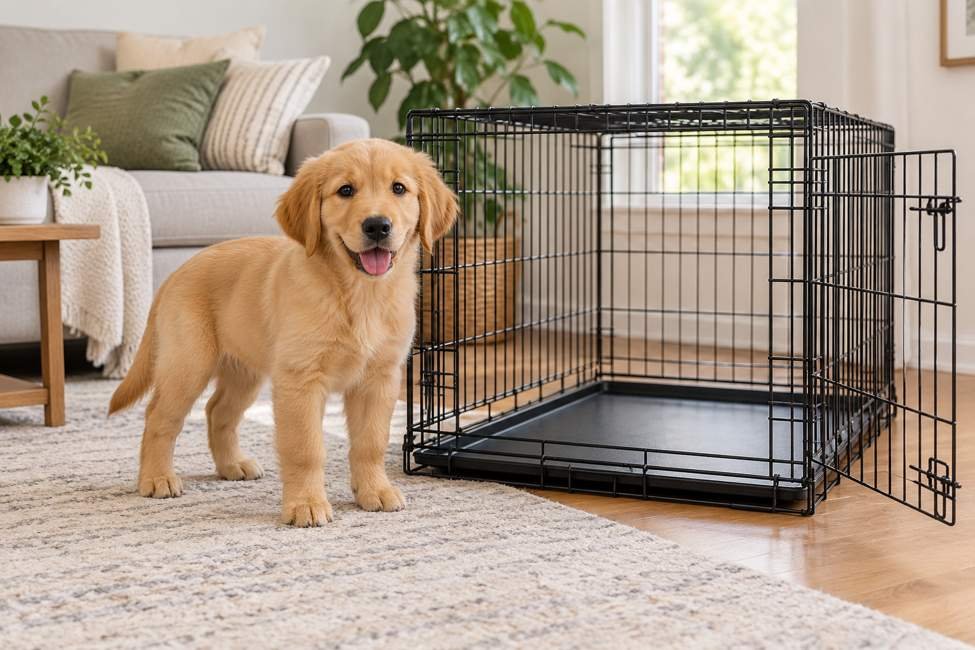
Shopping for your puppy’s first crate can feel surprisingly complicated. Should you choose wire or plastic, buy a larger size with a divider, or spend more on a collapsible design?
The best crates for puppies combine suitable space, practical access, and features that make daily care easier. The right choice depends on your puppy’s measurements, your home, and how you plan to use the crate.
For an everyday home setup, I would start by comparing adjustable wire crates. An enclosed plastic kennel or a premium collapsible model may make more sense when you have different priorities.
This guide compares five options, explains how to assess crate size, and highlights the features worth checking before you buy.
How these picks were selected: This is a research-based comparison using manufacturer specifications and published puppy-care guidance, checked October 28, 2026. The recommendations reflect advertised features and practical buying considerations, rather than hands-on testing or escape-resistance testing.
In this guide
Puppy Crates Compared at a Glance
Use this table to narrow your choices before comparing exact sizes. Each recommendation addresses a particular shopping priority; none is the right answer for every puppy.
On a phone, swipe sideways within the comparison table to see every column.
| Crate | Shopping priority | Advertised feature | Main consideration |
|---|---|---|---|
| MidWest iCrate | Everyday home setup | Divider and removable pan | Choose the exact size and door configuration |
| MidWest LifeStages | Thicker-wire construction | Divider and folding frame | Compare specifications with your other shortlisted models |
| Diggs Revol | Premium access and storage features | Collapsible design and puppy divider | Check weight and available space |
| Petmate Traveler Ultra Vari Kennel | Enclosed plastic style | Plastic shell and metal door | Check usable interior dimensions carefully |
| EliteField 3-Door Wire Crate | Flexible door access | Front, side, and rear doors | Confirm which openings your layout will actually use |
Start with your intended location and your puppy’s size. Those two details can eliminate unsuitable options before you spend time comparing accessories.
Best Crates for Puppies: Five Options to Consider
1. Best Starting Point for Everyday Use: MidWest iCrate
The MidWest iCrate is my first option to investigate when comparing the best crates for puppies for a straightforward home setup.
The manufacturer lists a divider panel, a removable plastic pan, folding construction, and single- or double-door configurations. The published range includes nominal lengths from 18 to 48 inches.
That combination gives you practical questions to evaluate without making the purchase overly complicated. Can you adjust the resting area as your puppy grows, clean the base conveniently, and place the crate where you need it?
I would choose the door arrangement before selecting accessories. A side opening may be useful in one room, while a single front entrance may be sufficient in another.
The main limitation is that a sensible feature list does not establish suitability for your individual puppy. You still need to inspect the assembled crate, assess the fit, and introduce it gradually.
Compare the exact model number rather than assuming that every retailer photograph shows the same configuration.
- Why shortlist it: A practical starting point for comparing essential puppy-crate features.
- Check before buying: Dimensions, included divider, door arrangement, and replacement-part availability.
- My buying view: Begin here, then decide whether another model solves a specific problem this one does not.
The linked listing currently selects the 42-inch double-door model. Choose a size using your puppy’s measurements.
2. Best for Buyers Prioritizing Thicker Wire: MidWest LifeStages
The MidWest LifeStages is worth comparing if construction is a major consideration in your puppy crate search.
MidWest describes this range as using thicker wire gauge. It also lists a divider, a removable pan, folding construction, and six size options.
Those features make it a logical alternative to investigate alongside the iCrate. However, thicker wire should be one comparison point rather than your entire purchasing decision.
Think about how you will use the crate each day. Will it remain in one room, need to move occasionally, or be folded for storage between uses?
Ask the seller for the assembled weight of your chosen size if lifting matters. A construction upgrade is less useful if the resulting crate is awkward for your household to handle.
I would also compare the actual footprint and door clearance with the space available at home. Similar-looking models are not automatically interchangeable.
This recommendation concerns advertised construction, not proof that the crate can contain a panicking puppy. If your dog is attempting forceful escapes, the training and welfare issue needs attention.
- Why shortlist it: A wire-crate alternative for buyers examining construction more closely.
- Check before buying: Exact specifications, weight, size, and selected door style.
- My buying view: Choose it when the differences matter to your setup, rather than simply because the name suggests durability.
The linked listing currently selects the 42-inch double-door model. Check the available sizes before ordering.
3. Best Premium Feature Set to Compare: Diggs Revol
The Diggs Revol is the premium puppy crate I would investigate if convenient access and storage features are high on your list.
Diggs lists a collapsible design, wheels, a removable tray, a garage-style side door, a ceiling hatch, and an included puppy divider.
Before paying for those extras, consider which ones you would use. A feature that improves your daily routine has more value than one you admire only on the product page.
For example, map out where the crate will stand and how you would reach it. Then decide whether the extra access points solve an actual placement problem.
The important trade-off is handling. Diggs lists its Small model at 25 pounds, so “collapsible” should not be read as “effortless to carry.”
Think through the full journey if you plan to move it: stairs, doorways, storage space, and the person doing the lifting.
I would shortlist the Revol when its particular features justify the additional spending for you. I would not assume that a more expensive crate produces faster training results.
- Why shortlist it: A detailed feature set for buyers who value access and collapsibility.
- Check before buying: Interior space, exterior footprint, folded dimensions, and weight.
- My buying view: Pay for conveniences you will use regularly.
The supplied Amazon link selects the Large Ash model, rather than the Small model used as a weight example above. Check the exact size, weight, and divider inclusion on the listing.
4. Best Enclosed Plastic Style to Compare: Petmate Traveler Ultra Vari Kennel
The Petmate Traveler Ultra Vari Kennel offers a different style to consider if you prefer an enclosed plastic crate.
Petmate describes a plastic shell with a metal door, side ventilation, assembly hardware, and an interior floor moat.
The main shopping question is whether this format suits your intended use. Consider where you will place it, how you will clean it, and how much visibility you want.
Give the interior measurements particular attention. Petmate lists the nominal 28-inch version with an interior measuring 24.25 inches long, 18.25 inches wide, and 19.5 inches high.
That example shows why a size name is not enough to determine fit. You need the space your puppy can actually use.
If growth adjustment is important, ask about a compatible divider before ordering. Do not assume a plastic kennel offers the same adjustment system as a wire crate.
Petmate also tells buyers to verify airline requirements directly. Treat any proposed flight as a separate suitability check for the exact kennel and journey.
- Why shortlist it: An enclosed alternative to open wire construction.
- Check before buying: Interior dimensions, assembly requirements, and intended-use restrictions.
- My buying view: Compare the layout and usable space before focusing on the nominal size.
The linked Amazon listing selects the 48-inch model. The 28-inch interior measurements above are an example from another size; confirm the usable dimensions of the size you order.
5. Best for Multiple Door Options: EliteField 3-Door Wire Crate
The EliteField 3-Door Wire Crate is worth investigating when access from different directions is important.
The manufacturer lists front, side, and rear doors, an included divider, a slide-out pan, carrying handles, and folding construction.
Its published sizes run from nominal 24-inch to 48-inch models.
The extra door option is the reason to compare this crate. Before buying, sketch where the crate will sit and identify which openings would remain accessible.
There is little benefit in paying for a particular layout if furniture will permanently block the door you wanted to use.
I would also check how each door secures in the open and closed positions. Make sure the configuration works for the people who will handle the crate.
The limitation is straightforward: an additional door is useful only when it improves your setup. If you have a simple placement with plenty of room at the front, a less complicated arrangement may be sufficient.
Be careful when ordering, because EliteField also sells soft crates. Confirm that the listing is the wire model discussed here.
- Why shortlist it: More entrance-position options to evaluate.
- Check before buying: Exact model, dimensions, door operation, and divider inclusion.
- My buying view: Choose it for a layout advantage you can clearly identify.
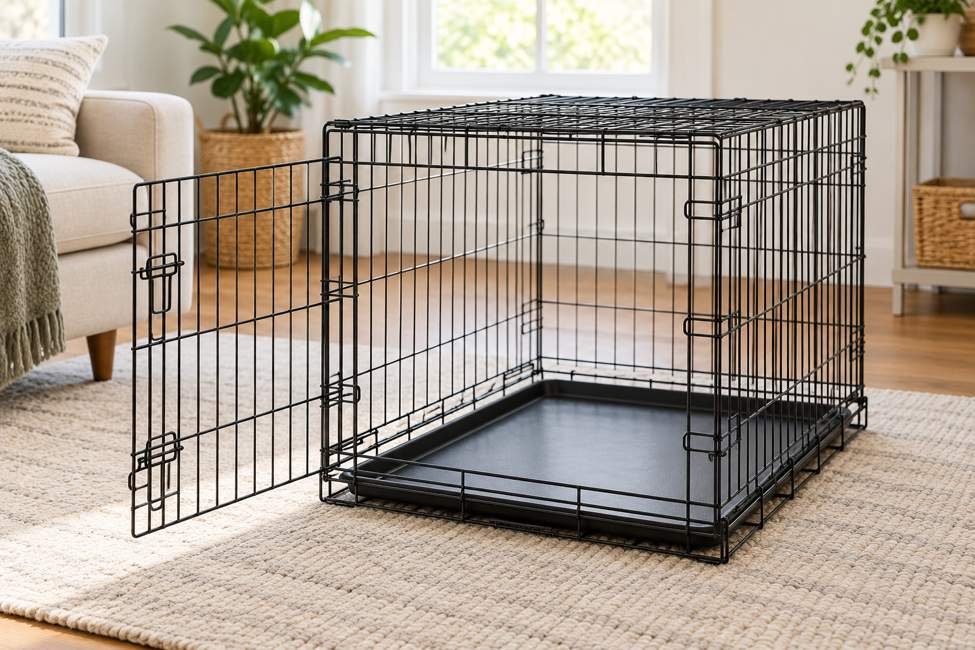
How to Choose the Right Puppy Crate Size
The correct crate size starts with your puppy’s body, not a breed illustration on a box.
Your puppy needs enough room to stand naturally, turn around, lie down comfortably, and stretch. A small footprint is not a saving if the usable space is unsuitable.
Measure before browsing
Record your puppy’s standing height and body length, then follow the sizing method supplied for the model you are considering.
Keep those measurements alongside the product’s interior dimensions. Check width as well as length and height.
If your puppy is still growing, discuss likely adult size with your veterinarian or breeder where appropriate. Treat any estimate as something to review as your puppy develops.
Separate interior dimensions from exterior dimensions
Interior measurements help you assess your puppy’s space. Exterior measurements help you assess whether the crate fits your room.
You need both.
Picture a crate that fits neatly beside your sofa but offers insufficient usable height. Now picture a suitable interior housed in a frame that blocks your bedroom doorway.
Neither is a good purchase, even if the advertised size sounds right.
Understand what a divider changes
A suitable divider can let you adjust part of an adult-sized crate while your puppy grows. It does not increase the crate’s width or height.
Follow the manufacturer’s installation instructions and reassess the space as your puppy develops. The puppy must still be able to rest and move comfortably.
A divider is a useful purchasing feature, but it cannot replace toilet breaks or make confinement appropriate for an entire working day.
Do not use a generic breed chart as your final answer
Breed-based charts are starting points. Individual proportions and the design of the crate still matter.
Rather than asking only, “What size do puppies of this breed use?”, ask, “Does this exact model provide suitable space for my puppy?”
That question leads to a more reliable decision.
Comparing Puppy Crate Styles
Wire crates
Wire models belong on your comparison list when visibility, folding storage, and divider options are priorities.
They allow you to observe your puppy easily. However, dogs attempting to chew or force their way through bars can injure themselves.
I would evaluate a wire crate as home equipment for a puppy being introduced to confinement gradually. I would not treat ordinary folding construction as evidence of vehicle crash protection.
Plastic kennels
Plastic designs are worth comparing when you prefer more enclosed sides. They can also be relevant to transport planning, subject to the requirements for the exact journey.
Look closely at the entrance, ventilation, internal shape, and assembly hardware. Ask how the model is stored when not in use.
Do not assume the outside length tells you how much resting space is available.
Soft-sided crates
A soft-sided model deserves a different set of buying questions. Ask whether the manufacturer recommends it for your puppy’s current training stage and behavior.
Investigate how the fabric, mesh, zippers, and frame are intended to be used. Consider whether cleaning and replacement parts would meet your needs.
I would not make this my default first purchase without understanding how the individual puppy behaves around fabric and confinement.
Furniture-style crates
Furniture-style designs may appeal when the crate will remain in a living space. Appearance should come after practical requirements.
Check ventilation, cleaning access, dimensions, assembly, and material guidance before considering the finish.
Ask yourself whether you would still choose the model if the decorative top were removed. That helps separate the crate’s usefulness from its styling.
Puppy Crate Features Worth Checking
A compatible divider
If you plan to buy for growth, confirm whether the divider is included, optional, or unavailable. Check compatibility with the exact model number.
Do not rely on a general photograph showing a divider somewhere in the product range.
Accessible cleaning surfaces
Before ordering, work through a realistic cleaning task. Can you reach the corners, remove the base as instructed, and access the area beneath the crate?
Think about where you will clean large components and how you will dry them before reassembly.
A design that looks convenient online may be awkward in a small home with limited washing space.
Doors that suit the location
Measure the clearance needed to open the door fully. Include the space where you will stand while helping your puppy enter or cleaning the interior.
An extra entrance matters most when it gives you a genuine placement option.
Clear assembly and operating instructions
Check that you can obtain the manual before purchase. Look for understandable instructions covering setup, latches, dividers, and folding.
If another person will care for your puppy, make sure they can operate the crate correctly too.
Replacement parts
Ask whether the seller can supply a replacement tray, divider, or other serviceable components. Check model numbers rather than assuming parts are universal.
Availability can influence the practical cost of ownership, particularly if you intend to keep the crate beyond puppyhood.
Weight and storage dimensions
Consider the size you are actually buying. A small model’s demonstration may not show how manageable a much larger version will be.
Measure the storage location and consider who will fold, lift, and move it.
Return terms
Read the seller’s conditions before assembly or use. Understand what happens if the size is unsuitable or the product arrives damaged.
A clear return process may be worth more than a small headline discount.
Plan Your Puppy’s Crate Setup Before Ordering
A crate is easier to choose when you know where it will live. Start with a room plan rather than a shopping basket.
Mark out the footprint
Use removable floor markings to outline the proposed exterior dimensions. Add the clearance required for the door and cleaning access.
Walk around that outline during your normal routine. Check whether it affects a doorway, storage cupboard, seating area, or route through the room.
Think about day and night
Consider whether you expect to move the crate between rooms. If so, compare that plan with the selected model’s assembled size and weight.
Do not assume something that folds for storage will be convenient to relocate twice a day.
Consider whether you need a pen as well
A playpen can provide a larger managed area than a crate alone. Dogs Trust describes using a pen around a crate as one possible arrangement.
That may change your shopping decision. Instead of buying the biggest crate available, you might need a suitable resting crate and a separately assessed activity area.
Choose accessories after the crate
Wait until you know the usable floor dimensions before ordering a fitted bed or mat. Check how any divider affects the available area.
Read the care and suitability guidance for accessories rather than assuming that everything marketed for puppies belongs in every setup.
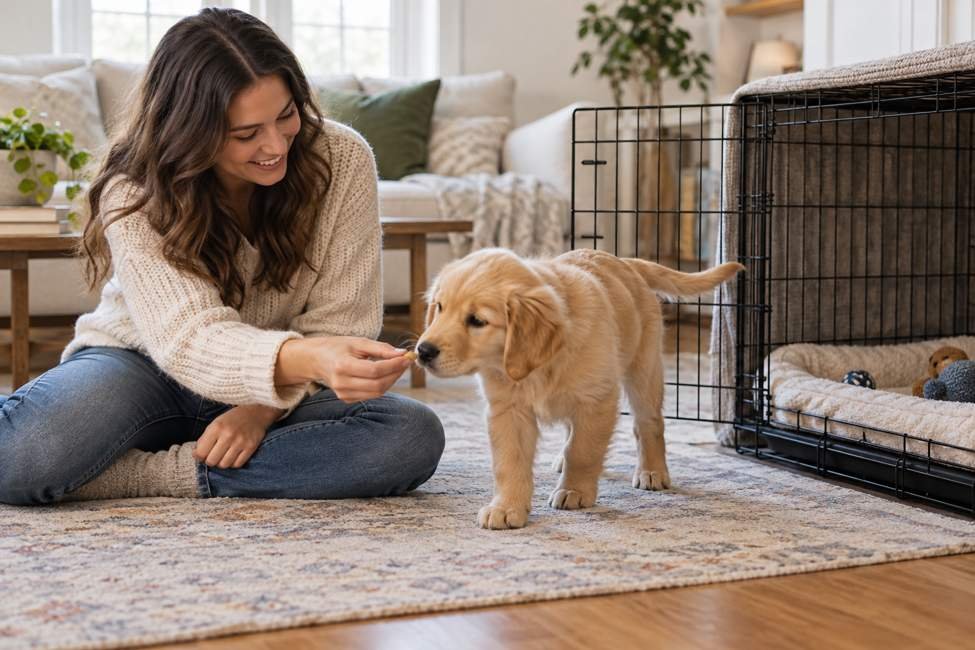
Introducing Your Puppy to a New Crate
Choosing equipment and teaching a puppy to feel comfortable inside it are separate tasks. A more expensive purchase does not remove the need for a gradual introduction.
Begin with voluntary exploration
Secure the door open and allow your puppy to investigate at their own pace. Build a pleasant association through appropriate rewards.
Dogs Trust recommends keeping the early experience positive and allowing easy movement in and out.
Progress according to comfort
Build duration gradually rather than starting with a long closed-door session. Plan your routine around toilet opportunities, interaction, exercise, and rest.
Never use the crate as punishment or leave a puppy confined throughout a working day.
Respond to distress
Persistent vocalizing, salivation, repeated escape attempts, or an inability to settle are reasons to reassess. VCA advises consulting your veterinarian when you are concerned about these signs.
Buying a stronger model does not address the reason a puppy is distressed.
Keep useful notes
Record what you attempted and how your puppy responded. Note the setting, duration, and any questions you want to ask a professional.
This makes it easier to discuss a specific difficulty rather than simply saying that crate training “is not working.”
Common Puppy Crate Buying Mistakes
Choosing by price alone
Compare complete setups. A lower-priced listing may omit a divider or require different accessories, while a bundle may contain items you do not need.
Judge the final purchase against your requirements.
Assuming size names are standardized
“Medium” and “large” are not measurements. Even nominal inch labels may refer to exterior dimensions.
Keep a written comparison of the exact usable space.
Paying for unused features
It is easy to be drawn to additional doors, handles, finishes, and accessories. Ask how each feature would improve your actual routine.
If you cannot name a use, it may not deserve a place in your budget.
Confusing portability with transport protection
Folding a crate for storage and protecting a puppy during a collision are different requirements. Check evidence relevant to the intended transport use.
For flights, verify the exact carrier requirements before purchasing or making travel plans.
Expecting equipment to replace care
A crate cannot provide toilet breaks, companionship, exercise, or individualized training. Build those needs into your plan before deciding how confinement will fit.
The best purchase is one you can use appropriately within that broader routine.
Common Questions About Puppy Crates
What is the best crate for a first puppy?
For a straightforward home setup, I would begin with a suitably sized wire model that offers the adjustment and access you need. Compare that starting point with your puppy’s behavior and your household requirements.
Should I buy for my puppy’s adult size?
That can be practical when a compatible divider is available. Recheck the fit as your puppy grows rather than assuming the initial arrangement will remain suitable.
Is a bigger crate always better?
Choose appropriate usable space, not the largest model you can fit in the room. A playpen may address a need for a larger managed area more effectively than changing the resting crate alone.
Are two doors better than one?
Only when the second opening helps your layout or handling. Check where the crate will stand before paying for additional access.
Can I use the same crate at home and for flights?
Possibly, but suitability must be confirmed for the exact crate, puppy, airline, and journey. Do not rely on a broad “travel” description.
Will a premium crate make training easier?
Useful features may make handling and setup more convenient. This comparison does not establish that a premium model teaches a puppy to settle faster.
What if my puppy tries to escape?
Pause and assess the situation rather than simply upgrading hardware. Seek professional guidance when escape attempts are persistent or forceful, or your puppy appears distressed.
Choosing the Best Crate for Your Puppy
The best crates for puppies solve a specific need: comfortable resting space, suitable growth adjustment, practical access, and a setup you can manage every day.
My starting shortlist is the MidWest iCrate for everyday essentials, the LifeStages for buyers examining thicker-wire construction, and the Diggs Revol for its additional convenience features.
Consider the Petmate option when an enclosed plastic style better matches your plans. Investigate the EliteField wire model when multiple entrance positions offer a clear advantage.
Before ordering, measure your puppy, mark out the crate’s footprint, and confirm what is included. Read the manual and return terms for the exact model.
Choose the crate that fits your puppy and your routine. Then give the introduction the same attention you gave the purchase.
For more everyday equipment guidance, read our PetSafe Easy Walk Harness review. For a separate home-learning option, see our Brain Training for Dogs review.